
“The very condition of having Friends
is that we should want something else
besides Friends.“
~ C.S. Lewis
We were a small group, mostly unknown to each other and brought together by shared interest in a philosophy class and a professor with the magnetism of a favorite uncle. He was standing waist-deep and fly casting in a small Poconos stream.
It was 1972 and we were freshmen in a secular university. We were reading a few of the ancient Greek philosophers and discussing their observations on logic, reason and truth: all three in harmony and intrinsically recognizable by most people. I was surprised to find illumination of my Catholic faith in this setting, without reference to Christianity in the teaching. Twelve years of Catholic schooling had failed to imprint the tradition of the Greeks and their influence on my faith, or perhaps I hadn’t been paying attention. This professor awakened something buried deeply, but at first all he seemed to want was nothing more than for us to break the horns of a moral dilemma – when either one of two choices is perceived as equally bad – by proving one or the other horn false using logic, reason and truth rather than the slogans of the day.
We watched the graceful arc of his casts as the stream slid by, smooth and deep. I don’t recall how or why we came to be streamside with the professor. It was to be a demonstration of sorts rather than a lecture on philosophy. He missed a fish or two, if I feign recollection; perhaps that was the point. Some philosophical concepts are more elusive than others. I do, however, accurately recall thinking that if ancient philosophers informed the foundation of my faith, perhaps flyfishing held clues to other mysteries.
About the same time as the streamside encounter with philosophy and flyfishing, I made friends with the sort one likes right from the start. Dave was of a certain class of friends from which I still have a few. It was true friendship, the kind that philosophers and saints describe: a natural tendency for mutual goodwill and communication over a long period of time, through good times and bad. He celebrated the birth of my children when he and his wife struggled to conceive. As he lay dying, it was the news of my father’s death that brought him to tears. Our friendship lasted 40 years, nearly to the day.
If college credits were available, we’d have earned them fishing streams throughout Eastern and Central Pennsylvania. It was a course without curriculum and term; the grade deferred. He has received his.
We learned about flyfishing and friendship over the years, and Aristotle naturally leads to Augustine and Aquinas for those who find that theology completes what philosophy alone cannot. The mysteries of faith will always remain mostly mysterious in this life. There are, however, flashes of insight in small and unexpected moments that reveal the inmost longing we naturally have for something more than mere moments.
This is a story of a thread of events, occasionally and delicately tugged along, as a fly fisherman may purposefully twitch a line. It has taken a long time to reach the end of its drift.
Clarity comes, if only for an instant, or at the end of a drift. For even a fish may briefly rise above the surface of its limitations.
Baptism
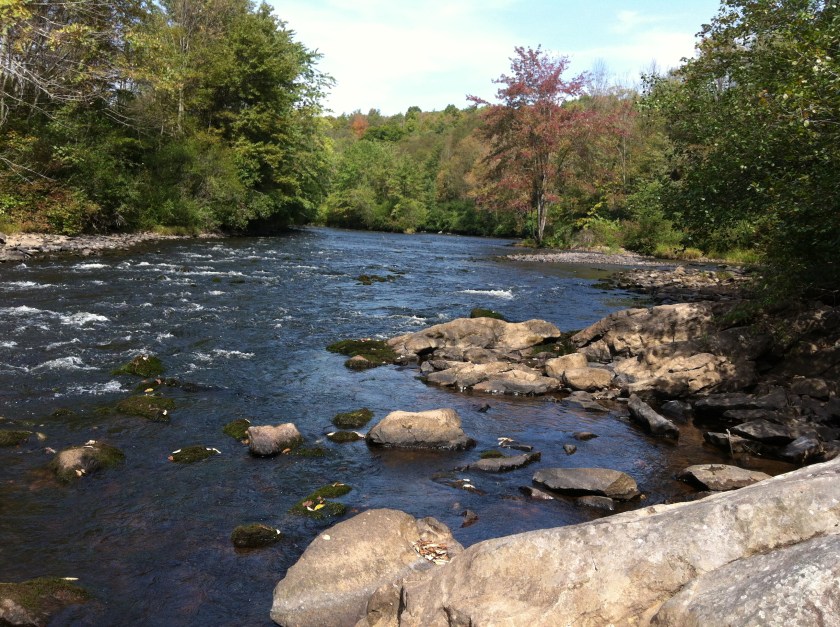
The Lehigh River crashed under the bridge, churning white froth and green menace with the late winter runoff. The road forked after crossing the bridge from the village. The upstream road was pitted, gravel and mud. Downstream the road was paved and the next logical turn. We went upstream in the direction of a presaged place that balanced the ability of Dave’s old Volvo coupe, nearly a classic at the time, to withstand the rough road and a fisherman’s reserve for a vigorous hike ahead.
We had only met the night before and somehow we were about to enter a wilderness together. Perhaps it was a mistake. The road narrowed and the woods seemed to grow darker. It was March and about 40 degrees.
In conversation the night before, Dave talked about fishing the local creeks, which he often called streams. They were all around us in our college town, he said, and trout season was coming. I grew up fishing slow water cricks, not creeks, and the warm waters of reservoirs; never fished trout, I explained.
We should go fishing, he said, in a way that it was already settled and not merely a suggestion. It wasn’t a problem that I didn’t have gear or a fishing license at the moment, he offered. He always had an extra rod or two in the car and he knew a spot where fish commissioners rarely go.
The road dissolved into a clearing in the woods. It seemed as though no one ventured this way, this far. Dave parked on the highest and smoothest patch of earth. The river was hidden from view, and the official start of trout season was a couple weeks away. We were to catch-and-release only on this stretch of the river, Dave said. We’d at least keep that part legal. There was an invitation in the woods, a gap in the trees and a downward tilt that hinted at the river below. It wasn’t going to be an ordinary walk in the woods and it set a standard for all future outings. A river of thin fog mirrored the stream below. A tangle of mountain laurel forced us to take lateral routes at times. The slope dropped suddenly to a steeper incline and the sound of the rushing water overtook interest in the placid mist. The stream came into view, fast and gurgling over big rocks and then forming occasional pools of flat water before colliding with the next boulder in the streambed. Dave pointed to a good spot from the bank for me and headed downstream to the next likely spot to cast.
We were spin fishermen the first year or two we went fishing, and this was an unfamiliar environment to me: slick rocks and sharp-edged boulders ahead, a mountain ridge behind. Fingers quickly became numb from cold. I made a few casts and mistook the telegraphed bump-bump of the split shot tumbling down the streambed for a fish taking the mealy worm bait. Dave moved a little further downstream and I took a few steps on the shifting flat stones to keep him in view. There was a narrow but fast torrent diverted by a boulder that was in my way, The boulder had a nearly flat top jutting into the stream. It looked like a vantage point to both cast a line and keep Dave in sight. It appeared to be an easy leap over the gushing riverlet to the boulder, and there was a foothold just above the water line. I missed it.
My chest slapped into the rock, expelling the breath I unconsciously took before the jump. I flailed for a handhold, handicapped as I didn’t want to give up the fishing rod in the other hand. I pumped my legs. The water rose or I sank. It was cold and fast and the bottom was loose stones, unlike anything I experienced in the slow, weed choked streams of my suburban neighborhood. I remembered to breathe.
I was on my knees with water to my chest when I stood to raise my waist above the water and clamored to the top of the boulder. The boulder felt oddly warm. I examined my hands and flexed all limbs. There were scrapes and embarrassment, but no real injury. That was the first thing Dave wanted to know when he suddenly appeared to help me to dry land where there was a group of boulders that formed a wind block. He didn’t say much; his actions spoke for him, for friendship. He started a fire with the flotsam gathered nearby, offered his coat and gave instructions to wring out my clothes.
There was a 20-minute uphill hike in 40-degree temperatures to the car. He worried about hypothermia and said we didn’t have time to waste. He would go ahead and keep me in sight while I dressed and followed. That way he could at least start the heater of the old car which never completely heated it anyway. As we drove out of the woods I apologized for ruining the day before we had a chance to catch any fish. He shrugged it off. It’s mostly about the fishing and not the catching, he said. We had the hike and the woods and the river, the first outing of the year. And now we had a story to tell, too. The episode rarely came up again, however, despite the opportunity for good-natured teasing throughout the years. We did remember the day briefly, 40 years later. Dave was in a hospital bed and he seemed to be withholding some information, as if he were protecting me again. We were reminiscing. “The day you went in,” he laughed hoarsely in the recollection, voice coarse and suddenly old. There was little else to say. There were looks for words. His were warm and caring with a hint of alarm, just as it was the moment the friendship began, the day I went in.
Apparitions
There are many ways into the gorge and Dave knew another hidden passage.
It was early May. The mountain laurel was getting ready to bloom. We were to hike down Stony Creek to its confluence with the Lehigh, a place Dave called Pumpkin Hollow. He said it with a hint of reverence or desire. And, oh, I should wear good boots.
He drove the old Volvo on roads without names, turning into a driveway with the innate sensibility of a GPS device decades ahead of its time. The driveway made a steep descent and turned left at the bottom. He parked off the drive, close to the hill. There was a little house in the bottom and no sign of movement, no barking dog. Dave opened the glove box, tore a scrap of paper from a larger piece and scratched a note about returning before nightfall. He placed the note on top of the dashboard and left the keys in the ignition.
I repeated this behavior, just a year or two after college graduation, with a plan to stay overnight. I came alone and expected to remain alone; I had never seen another person in the valley or hollow that wasn’t a companion of mine. I was interested more in the prospect of solitude over big fish, and nature as a proxy for something else that I could not define. Some call this searching spiritual-but-not-religious in the present age, as if one can exist without the other. Even the atheist has his creed.
There was an opening in the woods beyond the house leading to the downhill path that is often hard to discern. The woods were dense and the hill was steep. It is regrettable that stuttering footsteps and the clatter of stones pierce the quiet in such a place. Yet it is prudent that the cacophony scatters the rattlesnakes. A flat spot invited a pause to measure the moment: the stillness of the valley, scattered blue through the tree canopy, and labored breath under the too-heavy backpack. I packed for many contingencies, including two beers to chill in the creek.
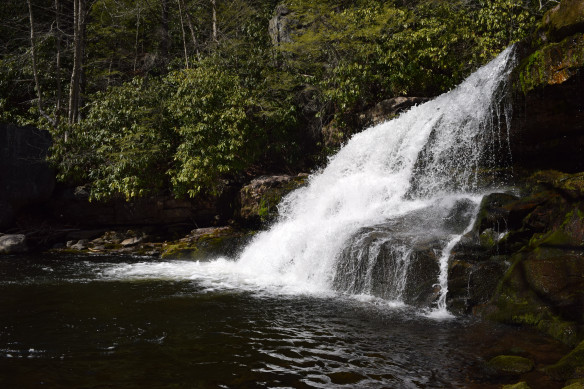
At the bottom, the sound of the stream overtook the clattering rocks and was calming. The downstream trail rose and fell along the creek. Mountain laurel, fallen branches and rock were frequent obstructions. I listened ahead for the sound of the waterfall I knew was there. I heard it or imagined it, a murmur different from other sounds, teasing louder downstream, a sound like human voices in a far-off crowd. Eventually the rumble and mist of the falls appeared ahead in the little valley and overtook the sounds of birds and breeze. This waterfall, like all waterfalls grand or tame, had power as discreet as gravity. From above or below, the 20-foot falls command all passersby to pause. There appeared to be a nearly flat spot, right sized for a one-man tent and stone fire ring, a little further ahead and higher on the right. The other option was to ford the stream and continue working downstream to find a campsite on the trail to the river. The high site had advantages. The ground might be drier, especially in the morning, than along the stream. One could see the stream below and enjoy the roar of the falls. It was a safe perch for a solitary camper.
The Lehigh and Pumpkin Hollow were another 10 or 15 minutes downstream, depending on the distractions or attractions one encountered. Pumpkin Hollow does not appear on current printed or digital maps; Dave probably had the name from some local authority. Google calls it Tank Hollow today after a stream below the Stony, at a point in a bend of the Lehigh. It’s a logical place name but without poetry.
There were only a few more hours of daylight. The valley would be prematurely dark when the sun fell behind the ridge. Fishing the river at dusk could be productive, but my confidence was weak. The trails in shadows at sunset are challenging. The practical thing was to set up camp for the night, gather firewood, and get comfortable alone in the wilderness place. The river could wait.
The tent was tiny and orange, two poles and six stakes, thin nylon walls and an unconvincing floor to prevent critters and dampness from entering. The backpack with food and cooking gear was strung on a tree at a distance, as Scouts are instructed. I’ve never seen bear in Lehigh Gorge, although they seem to pop up in the suburbs today. I tried not to think of the rattlesnakes.
Dry kindling and branches for a campfire were easy to gather in the out-of-the-way spot. I arranged nearby rocks for a fire ring. Blue sky and white light painted the highest treetops, but too soon soft oranges and reds would dust the treetops and predict the rapid descent to dusk, then twilight, then darkness. There was, however, still time to fish the little creek below my campsite. I heard the echo of the clattering rock as I made my way to the water on the shifting footing of red shale. The noise of my amateurish arrival and a few slashing casts put the fish down for the night.
There was no need for a fire except for the security of a warm glow in the dark. A watch was stashed somewhere in the camping gear but unimportant to the moment. I crawled into the tent and lay with my head at the opening, a few yards from the soft crackling of the fire that harmonized with the rush of the stream below. Sleep came fast and easy.
Time remained absent in the morning. There was an indeterminate light: the gray of earliest dawn or sunlight held back by dense clouds; I couldn’t be sure. The view up the valley revealed only wisps of green. The stream below, soothing white noise at night, seemed to grow louder as if announcing its run to the river. I remembered it was Sunday and had a sudden experience of joy without a particular prompt. It might have been the sum of all senses since stepping into this wilderness and a strange happiness in the isolation and quiet – a sense of not being alone in aloneness, if only for a meaningful moment. Yes, that truly is joy.
There was a stick of green wood in the kindling pile just outside the tent. I broke it and a pliable strip of bark came away from it. I crossed the pieces and tied them together with the bark strap. I stuck the small, rough cross into the ground and reviewed my plans for the day while propped up on my elbows at the entrance to the tent. There was a sudden but soft clattering of rock coming from the direction of the falls. Not far up the valley, in the direction I came the day before, a figure appeared. The figure seemed to be a man. A fisherman, or perhaps the landowner? He didn’t seem to carry a fishing rod or walking stick. He was unencumbered by a backpack. He did not pause to look into the pools. He walked with purpose, but for what I couldn’t imagine. He passed below me on the other side of the stream without looking up. Surely he saw the orange tent on the hillside, or noticed the smell of a campfire in this isolated spot. I suppressed the urge to call out, partly due to some innate fear and partly from desire to preserve as much as possible the natural order of things I thought I had established. The figure continued downstream without pausing and was out of sight as surreptitiously as he had appeared.
The interloper sped up the morning. There is a time to linger at a campfire and dawdle with strangers along a stream. This day was not to be one of them. I left the camp as it was, packed breakfast in the fishing vest and grabbed the flyrod.
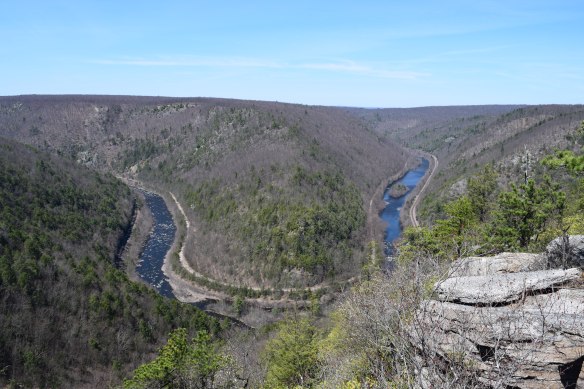
The sun was still below the rim of Pumpkin Hollow where the Stony meets the Lehigh. The sound of the much wider, rumbling river can be felt in the chest as much as heard in the ears. A railroad bed spooned the river on this bank. There was no one there, no figure walking the railroad tracks in either direction. One could float out if canoe or raft were available, or make a nearly vertical climb of several hundred feet to the top of more wilderness. There was no quick or easy escape.
I hollered “Hello” to the hollow. It was the first time in 24 hours I used my voice. The hollow returned the greeting two or three times. The river rumbled. The big water and the bright hollow contrasted with the covered and narrow passage to it. Another long look around revealed no other human presence. The original plan was for a walk downstream on the railroad tracks only so far so that I could return to the campsite well before sunset. It wasn’t long before there was a level place on the bank with a promising target 20 yards out. The river flattened below a riffle, and the deep pool might hold big fish. The first couple of rusty casts, products of an amateur’s anticipation which still returns at the start of each season, did not hit the mark. The river was loud and forgiving and I did not worry so much that I had already put fish down. Then I got lucky on a long, smooth cast; even an novice fly fisherman gets lucky once in a while. The line shot out and landed without a splash. The fly bobbed high on the undulating surface, disappeared in the riffle and reemerged floating on the flat water.
The trout came out of the water at that moment. It was big like the water. It was certainly bigger in the retelling, as all fish become. It arced clear above the surface of the water, tail flapping and head reciprocating, all 20 or more inches of the rainbow trout plainly visible, twisting in the sunlight and shedding water drops like sparks. The reentry splash was muted by the low roar of the river but the image was already etched in memory. Too late, I realized the line was limp. I tugged abruptly in a vain effort to set the hook in a fish that wasn’t there. The slack line raced across the surface of the river to the bank. I shivered and looked around for some validation that what happened had indeed happened. There were no witnesses and just the beginning of another fish story, this one about the biggest trout I never caught.
The best of the fishing that day had already passed with the miss. The trophy trout appeared and vanished as expediently as the interloper only an hour or two before. For many years, the story was always about the fish; the interloper was suppressed. It is hard enough to tell a fish story without injecting a questionable human story. But growing old inspires reflection on growing up. Who was the interloper? How and where did the interloper enter the valley? Where did he go? Why his haste and the silence between us?
There are logical and plausible answers if one were to pursue it. One thing is certain: The interloper was there for a moment, then gone, real or not, as elusive as the supernatural or as stealthy as a dream that may direct us where we might not otherwise have gone.
Cathedral
The place is little changed after more than four decades – despite the havoc of storms, floods and rafters. My sons fished this stream with me; perhaps my grandchildren will, too. With few exceptions, I have had little luck catching fish on this river over the years, and yet returned once or twice a year, even when there was precious little time for fishing. If the mark of insanity is doing the same thing over and over with the same result, but expecting a different one, then I am mad or a hopeless optimist. There were always possibilities, even unlikely ones, even if high water forecasts fishing failure. If this stretch were empty, perhaps fish were active around the bend. The search for a different outcome begins somehow, somewhere, sometime for most of us, and it began here for me.
An article in a flyfishing magazine introduced the idea of a stream-as-cathedral to us. It is on one’s knees that reverence is shown in a cathedral. One ought to also approach a small stream on the knees to prevent alerting wary trout with footsteps and shadow. Lehigh Gorge is the sanctuary of this natural cathedral, Lehigh Tannery the narthex.
In recent years there is a new level place for off-road parking. The descent from there has short, manageable drops to the rocky banks below, often wild with overgrowth. Sometimes an easier trail appears after groups of visitors are drawn to the site. There are other changes beside the regularly scheduled white water releases for the benefit of rafters. A sign informs the reader of the spot’s historic and economic influence. There were no markers when we first arrived. The oral history of the place was passed around campfires and in a local bar.
Long after glaciers carved the gorge, the railroad refashioned it after the discovery of anthracite coal in the watershed. Hemlocks were harvested in the gorge for the local tanning industry and the river ran black and dead from the byproducts. A great fire later ravaged the gorge. The river itself was controlled by the Lehigh Coal and Navigation Company for 143 years. The combination of a new Pennsylvania law and the national Clean Streams Act of 1965 transformed the gorge. We arrived five or six years later.
The village center in the time we knew it as college students consisted of a general store, a few houses and a small bar that ultimately became two or three unmarked parking spots on a rough roadside. The bar was knocked off its foundation by a derailed freight train in the middle of the night. The railroad tracks in the gorge grip the valley edges, forcing it into tunnels and sharp bends that might conceal a danger just ahead. There is a written history of train wrecks and lives lost in the 19th and early 20th centuries along this river stretch of the rail line; a record of the Tannery derailment in the 1970s is elusive. There was, however, a story that was passed around. A couple of cars jack-knifed alongside the bar one night after closing. The owner of the bar was thrown from his second-floor bedroom, rode his mattress like a flying carpet, and landed safely on the rubble of the building below with hardly a scratch.
It was a good story and it could have happened in such a place where old stories are retold. It’s plausible because we had heard the freight trains rumbling by from within the bar. The windows rattled and conversation paused until the great force passed.
There are three entrances to the cathedral on the east bank. One leads upstream along a trail high on the bank that seems to fade with the interest of walkers. Downstream are railroad tracks that take one deep into the gorge. Near the bridge are a few awkward steps down to the water, made more difficult in chest waders. It’s only in relatively recent years that Lehigh Gorge State Park opened trails on the west bank, a much easier way to access the gorge in all four seasons. I’ve never gone that way.
By coincidence or Providence, the Lenten and Easter seasons often intersect with the opening of trout season in Pennsylvania. Early trout season has its own sufferings and miracles, especially in this place, beginning with a cold baptism in the Lehigh. I was not much more than a boy then. I returned throughout the years and never caught more than one or two fish, but it was never supposed to be about the catching. There were suggestions in the shadows of the pools at times, occasional flashes of light in the water, fleeting hints of something in the deep.
I was drawn to the nature of this place despite my rough baptism. In time, there were other events to feed my fascination with the place, like the interloper on Stony Creek who faded into the fabric of a big fish story. Perhaps what occurred in the past can ultimately be understood, and even reach a happy conclusion, like the ruined barkeeper who rode a flying mattress to safety.
Next: Passion
 Practicing, Not Perfect